What My Electricity Bills Reveal About the Energy Affordability Myth
Energy affordability has been on my mind for years, and addressing the issue feels increasingly urgent. Unfortunately, much of the current conversation centers on the myth that renewable energy — often folded into broader “clean energy” discussions — is the root of the affordability problem. For clarity, when people talk about clean energy driving costs, they’re usually pointing to renewable sources like wind and solar, even though the broader clean energy transition includes much more than electricity generation.
Integrating clean energy into the existing energy system does involve real costs — for example, improving and expanding the transmission grid. However, those costs are not the primary driver of today’s affordability challenges. Many of these investments are necessary regardless. So let’s look at what’s actually happening.
I’ve spent much of my career working in the energy transition, so I pay attention when narratives about affordability start drifting from the data. That prompted me to look at my personal history of electricity rates over the course of my adult life. What I found reinforces something important: electricity prices have long been volatile and have generally trended upward over time.
As it happens, I’ve moved frequently and have been a rate-paying customer across four states and six electric utilities. Since I haven’t saved every utility bill I’ve ever received, reconstructing this history required some digging — and some estimation, including the use of average prices or blended rates. Even with those compromises, the data are solid enough to illustrate the broader trends.
Here’s what that history looks like:
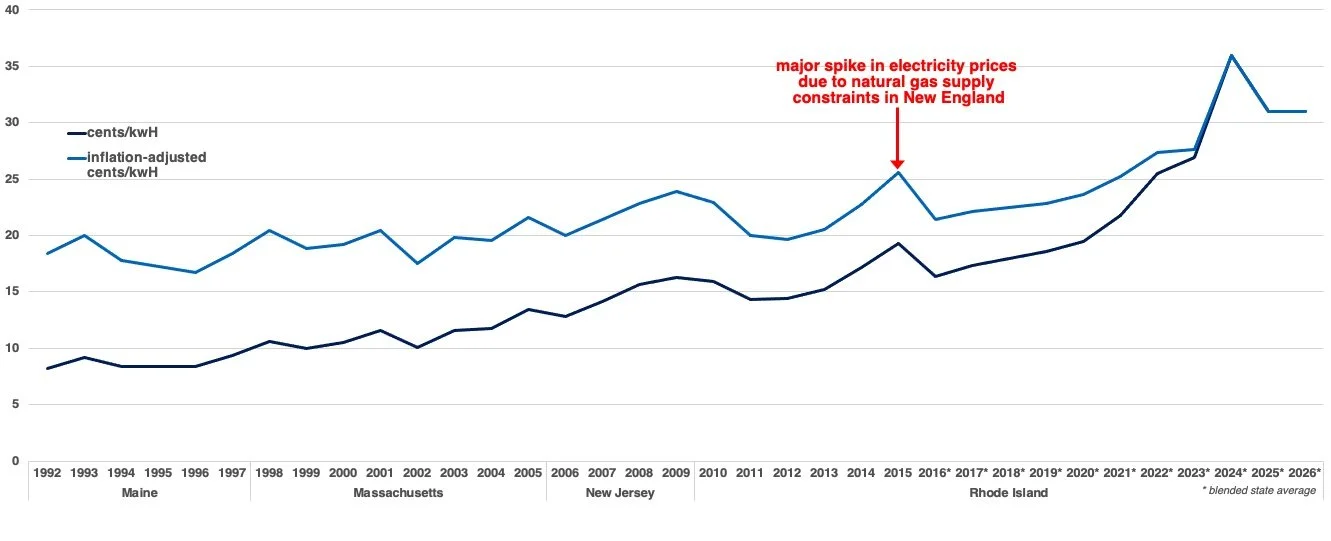
Chart of my electricity rates since 1992
A few things stand out immediately. First, volatility isn’t new — electricity prices have fluctuated for decades. Second, the upward trend began long before renewable energy became a meaningful part of the power mix. And third, some of the most dramatic recent spikes align closely with fossil fuel price shocks, particularly natural gas constraints in New England. That context matters when we talk about affordability.
So what is driving the high cost of electricity? What can we actually do about it? And what role does clean energy play?
Several factors are driving electricity affordability challenges, but clean energy deployment is not at the top of that list. Fuel price volatility — particularly natural gas, which often sets wholesale electricity prices — remains a major driver. Infrastructure investments to maintain reliability, improve resilience, and prepare for growing electricity demand also contribute. In some regions, legacy market structures and regulatory costs continue to shape retail rates. These pressures existed before large-scale renewable deployment and would persist even without it.
It is also worth noting that electricity markets ultimately reflect supply and demand. In New England, constrained natural gas infrastructure and delays in bringing new generation online have contributed to price volatility. Recent stop orders affecting offshore wind projects highlight how limiting new electricity supply can work against affordability goals. These projects are not instant price solutions, but over time they can reduce exposure to fuel price swings. If the goal is greater price stability, investing in a diverse portfolio of domestically sourced generation — alongside efficiency, demand flexibility, and grid modernization — can improve reliability while supporting evolving electricity needs.
So what can we actually do about electricity affordability? The short answer is that there is no single solution — but there are clear priorities. Reducing exposure to volatile fossil fuel markets is one. Improving energy efficiency and demand flexibility is another, since the lowest-cost kilowatt-hour is often the one we never have to generate. And modernizing the grid to improve reliability and accommodate evolving electricity needs is essential regardless of how quickly the energy transition unfolds.
This is where clean energy already plays an important role. Renewable resources like wind and solar have no fuel costs, which helps reduce exposure to global commodity price swings. A more diverse generation mix can improve system resilience and moderate price volatility over time. These resources are not instant affordability fixes. Integrating them requires planning, infrastructure, and investment, but they can contribute to longer-term price stability, particularly when paired with efficiency, storage, and demand-side strategies.
Clear, fact-based communication about what actually drives electricity bills is also essential. When affordability discussions focus on incomplete or inaccurate explanations, it becomes harder to build the public trust needed to support practical solutions. The energy transition is as much about clarity and confidence as it is about technology.
Electricity affordability is a real concern, and it deserves thoughtful, evidence-based discussion. Clean energy is not the primary driver of rising electricity costs — and in many cases, it can help address them. If we focus on the actual drivers of affordability challenges rather than convenient myths, we are far more likely to build an energy system that is reliable, sustainable, and genuinely affordable over time. It’s work I’m proud to be part of — and work that feels increasingly important right now.